
Thalassaemia: What Every UK Clinician Should Know
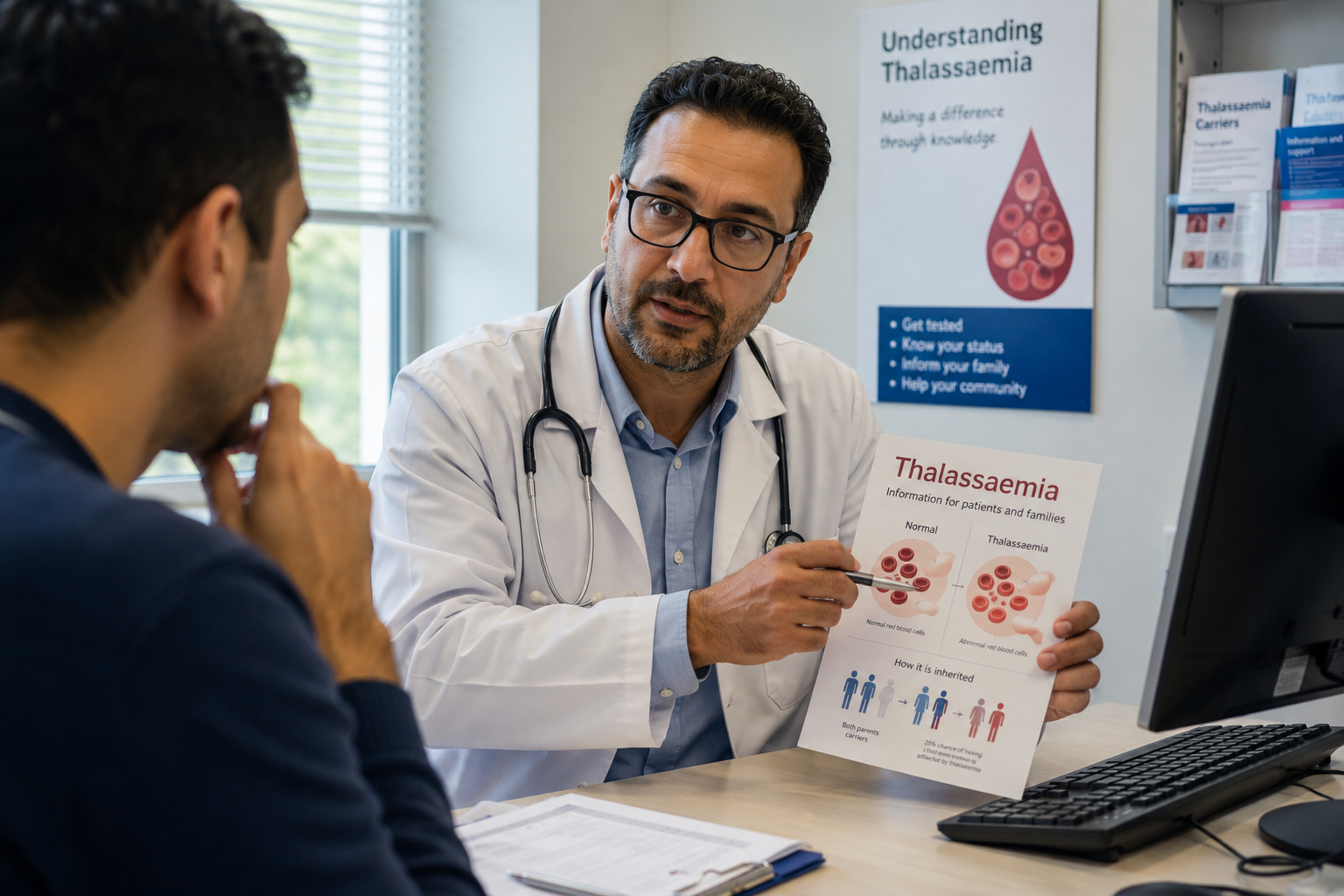
Thalassaemia is particularly relevant to the Cypriot community. A clear understanding helps clinicians support patients well.
Thalassaemia is a group of inherited haemoglobin disorders that affects the production of normal haemoglobin, leading to varying degrees of microcytosis, anaemia, and clinical disease. It is particularly relevant in the UK because of the country’s diverse population, and it has special importance for communities with Mediterranean, South Asian, Southeast Asian, Middle Eastern, and Cypriot heritage.
For many clinicians, thalassaemia is first encountered as an incidental finding: a patient with a persistently low mean cell volume, a mild anaemia, or a “microcytic picture” that does not quite fit with iron deficiency. Others may present through antenatal screening, family planning, paediatrics, haematology, or transfusion services. The clinical spectrum is wide, ranging from an asymptomatic carrier state to severe transfusion-dependent disease.
This spectrum matters. A patient with thalassaemia trait may be entirely well and need no treatment, but the diagnosis can still have important reproductive implications. If both biological parents are carriers of a clinically significant haemoglobin disorder, there may be a risk of a child inheriting a severe condition. In contrast, patients with thalassaemia major or other severe forms require lifelong specialist care, usually involving regular transfusions, iron chelation, and monitoring for complications.
One practical point for everyday medicine is not to assume that all microcytosis is iron deficiency. Thalassaemia trait often causes a low MCV and low MCH, sometimes with relatively preserved haemoglobin. Giving iron repeatedly without confirming deficiency is unlikely to help and may cause confusion or harm. A careful history, ferritin, haemoglobinopathy testing where appropriate, and awareness of family origin can prevent unnecessary treatment and allow appropriate counselling.
Screening has had a profound effect in many at-risk communities. Cyprus is a powerful example of how public awareness, premarital or preconception testing, and informed counselling can reduce the number of children born with severe thalassaemia while supporting families to make their own reproductive choices. In the UK, screening for thalassaemia is offered to all pregnant women in England, and biological fathers are offered testing when the mother is found to be a carrier.
The way results are communicated is just as important as the test itself. Being told that one is a “carrier” can sound alarming, particularly if the patient feels well and has never heard of the condition. Clinicians should explain clearly that carrier status is not the same as having severe thalassaemia. Most carriers live normal lives and do not need treatment, but the result may matter for family planning, partner testing, and future pregnancies. Clear, calm counselling can prevent unnecessary anxiety while ensuring that important information is not missed.
For patients with transfusion-dependent thalassaemia, modern treatment has transformed outcomes. Regular transfusion can manage anaemia and support growth, development, and quality of life. However, transfusions also lead to iron accumulation, which requires careful chelation therapy and specialist monitoring. Without adequate management, iron overload can damage organs such as the heart, liver, and endocrine system.
Non-specialist clinicians still play a significant role. A GP, emergency physician, surgeon, obstetrician, anaesthetist, or general medical doctor may be the first to see a patient with thalassaemia outside their usual haematology setting. Important considerations include recognising infection risk in splenectomised patients, avoiding unnecessary iron, considering transfusion history, checking for complications of iron overload, and involving haematology early when patients present acutely.
Pregnancy is another area where awareness matters. Women with thalassaemia trait may only need counselling and partner testing, whereas women with significant thalassaemia require coordinated care involving haematology, obstetrics, anaesthetics, and sometimes cardiology or endocrinology. Preconception counselling is particularly valuable, especially when both partners come from higher-prevalence backgrounds or there is a known family history.
The field is also evolving. Alongside established care with transfusion and chelation, selected patients may be considered for curative approaches such as haematopoietic stem cell transplantation. More recently, NICE recommended exagamglogene autotemcel, also known as exa-cel or Casgevy, with managed access for certain people aged 12 and over with transfusion-dependent beta-thalassaemia where stem cell transplantation is suitable but a matched related donor is not available.
For the Cyprus Medical Society UK, thalassaemia is not only a haematological condition but also a community health issue. Many Cypriot families are familiar with the impact that screening, education, and early counselling have had over generations. UK clinicians caring for patients from Cypriot and other higher-risk backgrounds should feel confident discussing thalassaemia in a way that is accurate, culturally sensitive, and practical.
Ultimately, every clinician does not need to be a thalassaemia specialist. But every clinician should recognise the key principles: think of thalassaemia in unexplained microcytosis, do not treat presumed iron deficiency without evidence, understand the importance of carrier screening and partner testing, communicate results clearly, and involve specialist services when disease is significant or reproductive risk is identified.
Thalassaemia is a condition where good public health, careful laboratory interpretation, sensitive counselling, and specialist care come together. Recognising this helps clinicians support not only individual patients, but also families and communities.
Written by
Cyprus Medical Society UK Editorial