
Building a Strong Portfolio for ARCP
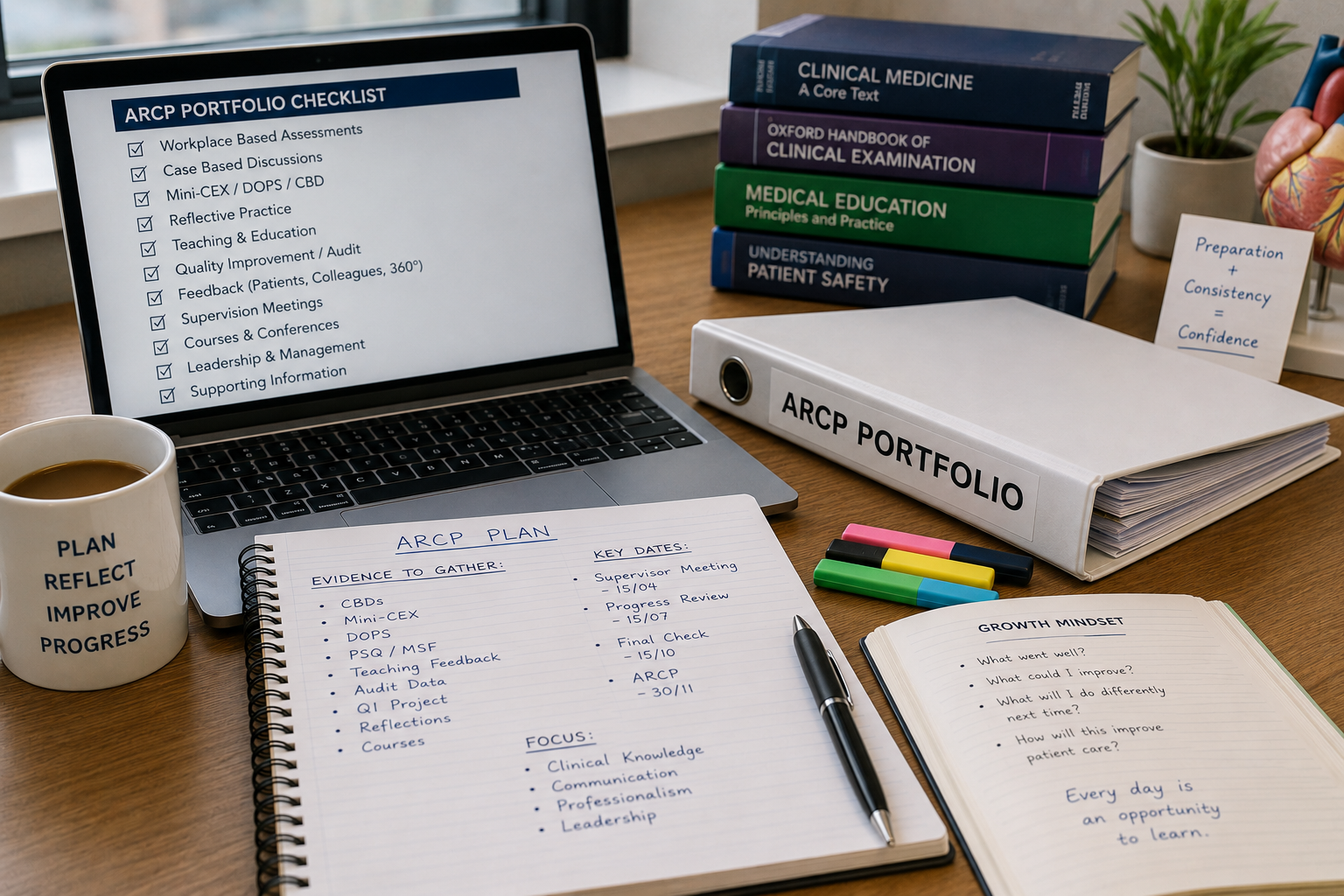
The ARCP is a milestone in every training programme. A steady, well-organised portfolio makes the review straightforward rather than stressful.
The Annual Review of Competence Progression, or ARCP, is an important checkpoint in postgraduate medical training. It is the process through which a panel reviews a trainee’s evidence and confirms whether they are progressing as expected for their stage of training. Although the ARCP can feel stressful, it should not come as a surprise at the end of the year. When approached steadily, the portfolio becomes less of an administrative burden and more of a useful record of professional growth.
A strong portfolio is built gradually. The most difficult ARCPs are often those where evidence has been left until the final few weeks, leading to rushed reflections, missing assessments, and last-minute emails to supervisors or colleagues. In contrast, trainees who update their portfolio throughout the year usually find the process much more manageable. Small, regular additions after clinics, ward rounds, on-calls, teaching sessions, procedures, and feedback conversations can make a significant difference.
Good evidence is not simply about quantity. A portfolio should show breadth, progression, and engagement with training. Workplace-based assessments are important, but they are only one part of the picture. A well-rounded portfolio may include case-based discussions, mini-clinical evaluation exercises, direct observation of procedural skills, reflective entries, teaching feedback, quality improvement work, audit activity, leadership experience, courses, simulation training, patient feedback, colleague feedback, and evidence of involvement in departmental or educational activity.
Reflection is particularly valuable when it is honest and specific. The best reflective entries do not simply describe what happened. They explain what was learned, why it mattered, and what will change as a result. A reflection on a difficult communication scenario, an unexpected complication, a challenging on-call shift, or a piece of feedback can show maturity and insight when written thoughtfully. It does not need to be dramatic or overly long. It simply needs to demonstrate learning.
It is also helpful to think about the portfolio as a story of development. The panel is not only looking for isolated pieces of evidence; it is looking for signs that the trainee is becoming safer, more confident, more reflective, and more independent over time. Evidence should therefore show progression across the year. Early assessments may identify areas for improvement, while later assessments can demonstrate how these were addressed. This creates a much stronger narrative than a collection of disconnected forms completed at the last minute.
Regular meetings with the educational supervisor are essential. These meetings should not be treated as a box-ticking exercise. They are an opportunity to check whether the portfolio is on track, identify gaps early, discuss concerns, and agree a realistic plan. Any issue is easier to address with several months’ notice than a few days before the ARCP deadline. Trainees should leave each meeting with a clear understanding of what evidence is still needed and how they will obtain it.
Clinical supervisors and senior colleagues can also help. Asking for assessments soon after a relevant clinical encounter usually leads to more meaningful feedback. A case-based discussion after managing an interesting patient, a procedural assessment after a supervised procedure, or feedback after a teaching session will be more accurate and useful when completed close to the event. It is often better to request assessments little and often rather than relying on a small number of seniors near the end of the placement.
Quality improvement and teaching evidence should be planned early. Many trainees underestimate how long these activities take to complete properly. A quality improvement project needs time to identify a problem, collect data, introduce a change, and ideally complete a second cycle. Teaching evidence is stronger when it includes planning, delivery, feedback, and reflection. Starting early allows these activities to become meaningful rather than rushed.
Organisation makes a major difference. Keeping a simple personal tracker can help trainees monitor what has been completed and what remains outstanding. This might include assessments, mandatory courses, reflections, supervisor meetings, teaching sessions, audit or quality improvement work, and feedback forms. Spending a few minutes each month reviewing the portfolio can prevent the familiar end-of-year panic.
It is also worth remembering that the ARCP panel is not looking for perfection. Training is about progression. A strong portfolio can include challenges, mistakes, uncertainty, and areas for development, provided there is evidence of insight and improvement. In fact, a portfolio that shows thoughtful engagement with difficulty can be more convincing than one that tries to present an unrealistic picture of constant success.
For Cypriot trainees working in the UK, the ARCP process may initially feel unfamiliar, especially for those who studied or trained partly outside the UK system. The expectations, terminology, and portfolio platforms can take time to understand. This is where peer support and mentorship can be particularly useful. Speaking to someone who has recently completed the same stage of training can help clarify what good evidence looks like, how much is usually expected, and how to avoid common mistakes.
The Cyprus Medical Society UK encourages trainees to approach the portfolio as a continuous record of growth rather than a last-minute administrative task. Members who are further along in training can offer practical advice, examples of useful evidence, and reassurance about the process. Sharing experience within the community can make the ARCP feel less intimidating and more manageable.
A strong portfolio is ultimately built through steady habits: regular evidence collection, honest reflection, early supervisor meetings, timely feedback, and attention to gaps before they become problems. Done well, the portfolio is more than a requirement for progression. It becomes a record of the trainee’s development, achievements, learning, and readiness for the next stage of their medical career.
Written by
Cyprus Medical Society UK Editorial